Small decisions beside a talking bear
I was playing hide-and-seek with a talking teddy bear when it promised to come looking for me and went quiet. The bear was still a prototype on my screen. It had a tool to set a wake timer, which is how it gets another turn while I'm hiding. It had finished speaking without setting one. We could have sat there a long time.
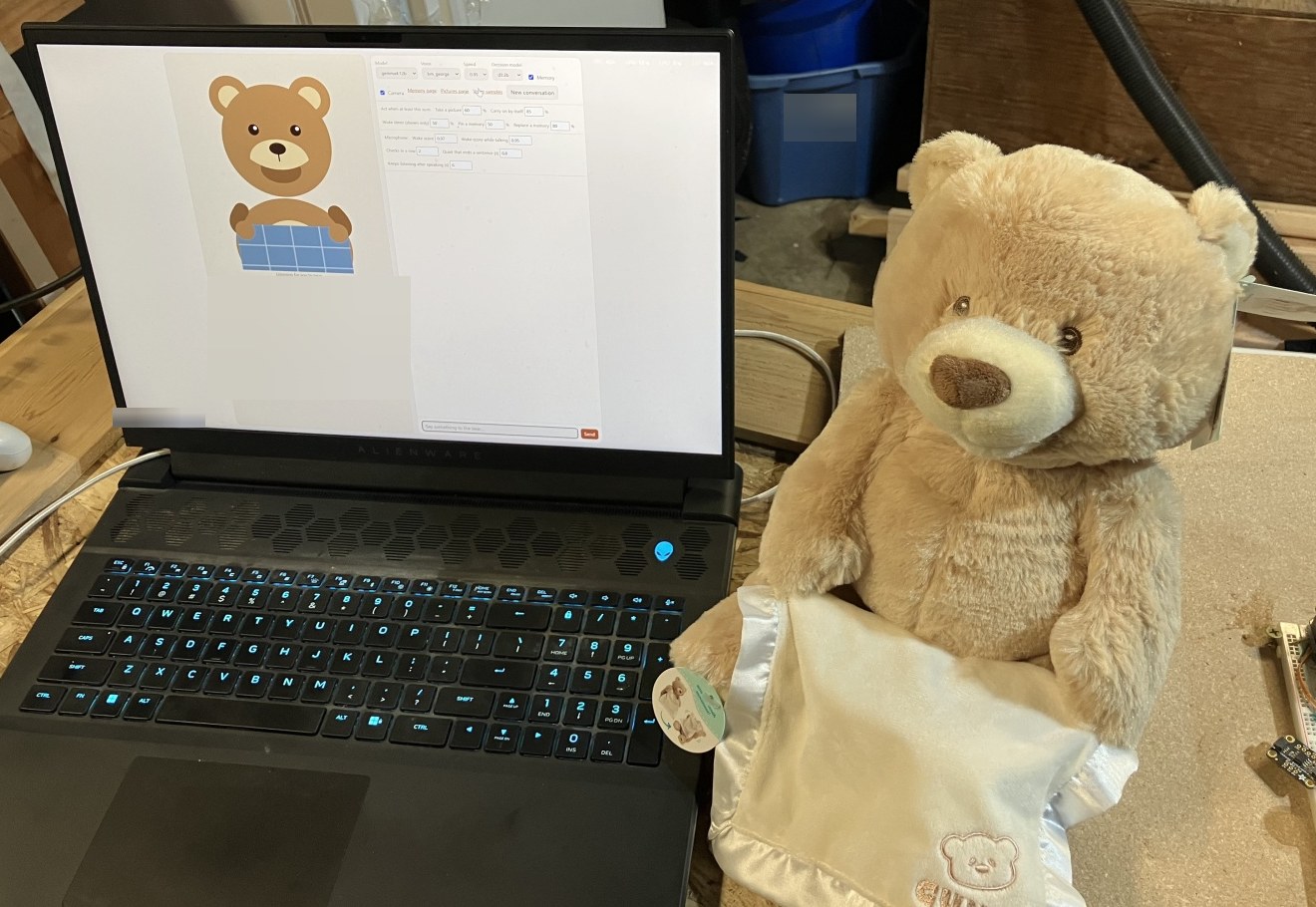
I asked Claude Code to show the last few lines of conversation to a small decision model. Should the bear have a timer running right now? For the first version I just wanted the score on screen.
That's how I've been using decision models. I supply the evidence and the possible answers. The model returns a probability for each, and my code decides what to do with it. On that hide-and-seek turn, the two-billion-parameter model gave “yes” an 18% chance. The four-billion-parameter model gave it 85%. I ran the smaller one anyway. It fit beside Gemma, the bear's chat model, on my laptop's 16 GB GPU and answered in about 50 milliseconds. With the larger one I could hear the cost of swapping models in the silence between turns.
Why I had a decision model on my gaming laptop#
I'd been reading about Jev and decision models on Hacker News for a few months. I wanted to try one and figured I'd find a use for it eventually. What got me to fire up the gaming laptop was a post from the Strands team about labeling tickets at Amazon. They'd been asking Sonnet to read each ticket and pick from 20 labels. They gave that job to a small decision model and estimated a 98% drop in cost per ticket.
I had a problem of my own where I could check the answers. I have two lists of records with no common ID and years of hand-corrected matches. The day before the hide-and-seek game, Claude ran the local d3:4b model over 165 records. Given the available fields and one rule about which records could be paired, it got 163 right, at about a third of a second per record. My existing matcher got 153 and took about three milliseconds.
On the earlier names-only test, choosing from a list of candidates got 158 right. Asking “Do these two match?” separately for each candidate got 115 right and took eight times as long. Most of the errors were refusals to match. I’d thought I was asking the same question either way. The matching runs
The bear that wouldn't stop reading#
Back in the bear, I had questions either side of a reply. Does the bear need a picture or something from its book to answer me? Afterward, did the bear actually do what it promised? I let that last check trigger an extra turn if the bear announced it was about to look around and then sat still.
Then I asked it to pause a story. “Of course, I will stop right here,” it said. The decision model gave that reply a 97% score for stopping too early. The app gave the bear another turn and told it to go ahead. It went right back to reading.
“I will stop” fits the wording I'd given it about announcing something you're about to do. Adding waiting and pausing to the description of a complete reply brought that example down to 20%. Another evening the bear asked me a question and carried on before I could answer. That fix fits in a line of code. If the bear ends with a question mark, wait for me. The prompts, scores, and replays
I also tried asking Gemma itself for a one-word answer and reading the probabilities of its first token. It did well on the bear's examples, though its scores were almost all 0% or 100%. With OpenAI's Luna Decisions interface I could send the conversation once and ask several questions about it. On 131 mostly hand-written bear examples, Luna got 131 right with the questions asked individually and 130 with them grouped. For a voice app, getting the camera and book decisions back in one round trip is a good reason to care. The local and hosted comparisons
Letting the journal show its guess#
The bear grew into Familiar, an engine for a few voice assistants. I used decisions to filter what they remembered and to help a desk operator choose between answering from its notes and putting me through to Claude. My favorite use so far is a bullet journal that runs entirely on my Mac.
Take the request at the bottom of this test page. I've picked up the dry cleaning, and I want to remember that the cleaner closes at five. A local assistant called the Keeper can cross off the task and add the note, but it takes a while. In the meantime, a decision model guesses which parts of the page will change.
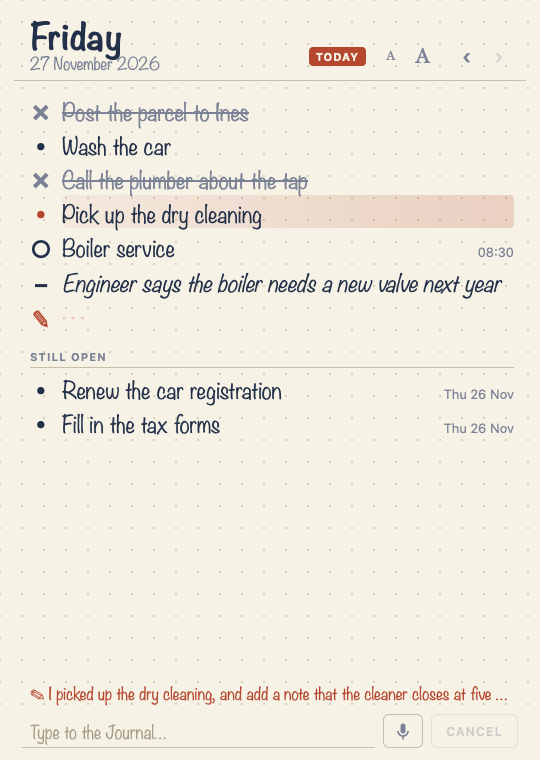
On a test page with nine entries and 36 invented things to say to it, the 4B model picked out all 27 expected changes, with one extra highlight. I tuned the wording and threshold on those same examples. The part I like is what happens when it guesses wrong. The bear interrupted my story. The journal briefly points at the wrong line. I started by putting a score on screen so I could watch the model work. Here, seeing which line it thinks I meant is useful in its own right. The journal experiment
Thanks to Adafruit and M. LeBlanc-Williams for Robotic AI Bear using ChatGPT, the guide that got me interested in working with the bear.